Showing posts with label jet. Show all posts

Sunday, March 27, 2011

The Sukhoi T-50


The Cold War was over but the ever-continuing race for space supremacy doesn’t mean to end. Allied or opposing nations may come in terms to agree with each other on common grounds but deep inside each will have the self reservation to secure their individual interests should any eventuality arise that each must face each other on the battlefield for a conflict of interests that couldn’t be resolved on the bargaining table. As history repeats itself, mankind will have to forget the lessons it learned through hard times of lives lost and edifices destroyed in acts of war for the same reason, insecurity .

Keeping in circulation to adapt to the call of the times, Russia just need to keep up with the west in pursuing her strategic capabilities as a once powerful nation. The state of worldwide economy just seems to make everything unstable and with it comes the worst possibilities which could be expected.

The Sukhoi T-50 PAK-FA (Perspektivny aviatsionny kompleks frontovoy aviatsii) or “"Future Frontline Aircraft System" in literal translation is a 5thgeneration jet-fighter developed by Sukhoi for the Russian Air Force. By the status of the program, it was meant to compete with the US built Lockheed-Martin F-22 Raptor and the F-35 Lightning II. Russia’s Sukhoi and India’s HAL (Hindustan Aeronautics Limited) has joined forces for building two variants of this aircraft, a single-seater of about 200 units and a twin-seater of about 50 units for Russian Air Force with 200 twin-seater units and 50 single-seater variants for the Indian Air Force.

he Soviet Union’s need to replace the fleet of Mig-29 Fulcrums and Su-27 Flankers came about in the late 80’s which were met with two options, the Sukhoi Su-47 Berkut and the Mikoyan Project 1.44. Sukhoi won the contract of developing the new combat aircraft in 2002 and the design for a prototype was approved in 2009 which integrates both technologies from the Su-47 and the Mikoyan Project 1.44. The first prototype took to the skies in January 2010 out of the 3 built. Information on the fighter was highly classified however photographs taken of the prototype reveals its striking similarity with the US built F-22 Raptor which incorporates both stealth and supercruise capabilities thus it is assumed that the Russian fighter itself features the same strong points.

Performance Specifications based on data from Warfare.Ru

Performance

* Maximum speed:Mach 2.45 (3,000+ km/h, 1,850+ mph)
* g-limits:(9 g)
* Cruise speed:1,800 km/h (1,100 mph)
* Ferry range:4,000 to 5,500 km (2,500 to 3,400 mi)
* Service ceiling:20,000 m (65,617 ft)
* Rate of climb:350 m/s (68,898 ft/min)
* Wing loading:470 kg/m² (96.3 lb/ft²)
* Thrust/weight:1.4 (dry thrust)
* Runway:350 m (1,148 ft)
* Endurance:3.3 hrs (198 mins)

Saturday, March 26, 2011

Mig-29 Fulcrum


Mig-29 Fulcrum Specifications
Version Mig-29 Fulcrum
Manufacturer(s) Mikoyan-Gurevich
Country Russian Federation/ USSR
Role Multi-role fighter
Powerplant Klimov RD-33K turbofan engine (2x)
Thrust 86.4kN 19,400 lbs (with afterburner)
Length 17.37m 57ft
Height 4.73m 15.6 ft
Wingspan 11.4m 37.3ft
Weight 11,000kg 24,250 lbs (empty)
Speed 2,430km/h 1,510mph
Range n/a
Ceiling 17,000m 55,800ft
Crew 1
First deployment n/a
Cost n/a


The MiG-29 is a widely exported aircraft, flown by Russia, Bulgaria, Croatia, Cuba, Czech Republic, Germany, Hungary, India, Iran, Iraq, Kazakhstan, Malaysia, Moldova, North Korea, Poland, Romania, Slovakia, Syria, Turkemenistan, Ukraine, Uzbekistan, Yemen and Yugoslavia.
In total, over 800 were delivered to the Soviet / Russian Tactical Air Forces and around 500 airframes prepared for initial export customers.
By 1989, it was serving in 12 different air forces around the world.
Presently, it is the only Russian aircraft on operational duty in NATO and serves in 21 air forces.
Brassey's reports that a total of 1216 MiG-29 single-seaters and 197 MiG-29UB dual-seaters were built by January 1985 (total of 1413). Since 1990, production was exclusively for export.

The MiG-29 has a few advantages over its more electronically advanced American counterparts. At about 40 miles apart, the American planes have the advantage because of avionics. At 10 miles the advantage is turning to the MiG. At five miles out, because of the MiG weapons sight and better maneuverability, the advantage is to the MiG.
The mission of the MiG-29 is to destroy hostile air targets within radar coverage limits and also to destroy ground targets using unguided weapons in visual flight conditions.
The aircraft's fixed-wing profile with large-wing leading-edge root extensions gives good manoeuvrability and control at subsonic speed, including manoeuvres at high angles of attack. The maximum operational g-loading is 9g.

The MiG29B was designed later on as a two-seated combat trainer. There is also a MiG29C with extended fuel capacity, of the 21 Fulcrums the United States bought, 14 are the frontline Fulcrum C's, which also contains an active radar jammer in its spine, six Mig 29A versions and one B-model of training.
During 1989 and 1990 a naval version was also under testing under the name MiG29D.

The latest version of MiG29 is the Super Fulcrum, MiG29K. The MiG-29K differed from the MiG-29 production model, featuring a new multi-function radar.
It is a highly improved MiG29, but unfortuately it hasn't been produced in great numbers.
The aircraft has a remote control system, large-area (42 m2 vs 38 m2) folding wing, adjustable center-line air intakes with retractable screens protecting the engines during operation from ground airfields, reinforced landing gear, hook, corrosion- protected reinforced fuselage made specifically for deck-based aircraft.

The German 'Bundeswehr' inherited 20 single-seater and 4 twin-seater MiG-29 aircraft from the former East German forces after the cold war.
After these Fulcrum aircraft had been upgraded to western standards, they received the designations MiG-29G (for Germany) and MiG-29GT (Germany/Trainer).

The MiG-29 fighter is equipped with seven external weapon hardpoints.
The aircraft can carry: up to two R-27 air-to-air medium-range missiles; six R-73 and R-60 air-to-air short range missiles; four pods of S-5, S-8, S-24 unguided rockets; air bombs weighing up to 3,000kg; and 30mm built-in aircraft gun with 150 rounds of ammunition.

During the NATO actions in Kosovo, on the 24th of March 1999, a Dutch F-16 shot down a Serbian Mig-29.

Armament:

# One 30mm GSh-30L cannon with 150 rounds
# Six Air-Air Missiles; including a mix of SARH and AA- 8 Aphid (R60) AA-10 Alamo (R27T) AA-11 Archer (R73) FAB 500-M62, FAB-1000, TN-100,
# ECM Pods
# S-24 AS-12, AS-14
Versions:

* Mig-29 " Fulcrum-have ": Basical version. Feature: to see above.
* Mig-29UB " Fulcrum-Bs ": Two-seater Training version.
* Mig-29S " Fulcrum-Cs ": Modernized version of Fulcrum-H.
* Mig-29SE: Export version of export of the Fulcrum-C.
* Mig-29K " Fulcrum-Ds ": Aircraft Carrier based version of the Mig-29. (based on Kusnetzov Carrier)
* Mig-29M: Last version of the Mig-29, completely revisited.
* Mig-29ME: Export Version of the Mig-29M.
* Mig-29G: German upgraded version
* Mig-29GT: German upgaded two-seater trainer

JAS-39 Gripen


JAS-39 Gripen Specifications
Version JAS-39 A
Manufacturer(s) Saab
Country Sweden
Role fighter / attack / reconaissance
Powerplant Volvo Aero RM 12 (General Electric F404J) (1x)
Thrust 80,0kN 18.000 lbs (with afterburner)
Length 14.1m 46.3ft
Height 4.70m 15.5ft
Wingspan 8.4m 26.3ft
Weight Approx. 6.500kg 14,600 lbs (empty)
Speed Mach 1.15 (1400km/h) at sea level; close to Mach 2
Range n/a
Ceiling 50,000ft 15km
Crew 1 (two in JAS-39B)
First deployment n/a
Cost US$ 25 million (1998)

Gripen is one of the world's best light weight multi role combat aircraft in production. It is now fully operational with the Swedish air force with more than 115 delivered.
As of January 2002 more than 25 000 missions have been flown resulting in more than 20 000 flying hours.
JAS 39A is the single-seater version of the Gripen. A two-seater JAS 39B operational trainer variant of Gripen is available. The JAS 39B is equipped with the same avionics and weapons suite as the JAS 39A, with the exception of the gun. JAS 39C is the single seat Batch 3 and export standard version, which was first delivered to the Swedish Air Force in September 2002. JAS 39C has colour cockpit displays, on-board oxygen generation system (OBOGS) and in-flight refuelling capabilty. JAS 39D will be a similarly upgraded two seater.

Deliveries of series aircraft to the Swedish air force are in progress. 204 aircraft, including 28 two seaters, are on order.
By June 2002, more than 120 have been delivered. Two squadrons at F 7 are equipped and two at F 10, and they're being introduced at F 21 and F 17.
In November 1998, the South African Air Force ordered 28 Gripen multi-role aircraft. Denel Aviation of South Africa will produce part of the centre fuselage. In November 2001, Hungary signed a Memorandum of Understanding for the lease of 14 aircraft; 12 JAS 39A single-seat and two JAS 39B. This agreement was revised in February 2003 and the single seat aircraft will be upgraded to the JAS 39C configuration. Deliveries began in 2006.
Export

The export version, being marketed jointly by BAE Systems and Saab, will not be identical to the Swedish air force version. Exactly how it will be configured of course depends on customers' needs, but it can be assumed it's close to JAS 39C in configuration.
As with all major weapon systems, there does not exist a "dollars per airframe" price tag. It's much more complicated than that, possibly with payment in a basket of currencies, to different schedules and with different offset deals included.
A NATO-compatible prototype has been readied. Apart from making it NATO-compatible in general, with connectors and so on, it has got a retractible aerial refuelling probe, which could be fitted without removing any other system. As missions can last much longer, this version also has an on board oxygen generating system.
In March 1998, Ericsson Saab Avionics was selected as the supplier of the export Gripen integrated countermeasures system, EWS 39, including warning, jamming and expendable countermeasures systems. In May 1999, Denel Aviation was chosen to supply the NATO compatible stores pylons for all export Gripens.

Gripen is designed for the high demands put on flying performance, flexibility, effectiveness, survivability and availability the future air combat environment will put.
The designation JAS stands for Jakt (Fighter), Attack (Attack) and Spaning (Reconnaissance) and means every Gripen can fullfill all three mission types.
Flying properties and performance are optimised for fighter missions with high demands on speed, acceleration and turning performance. The combination of delta wing and canards gives the JAS 39 Gripen very good take off and landing performance and superb flying characteristics.
The totally integrated avionics makes it a "programmable" aircraft. With the built in flexibility and development potential the whole JAS 39 Gripen system will retain and enhance its effectiveness and potential well into the 21st century.

Rafale


The Rafale is a fourth-generation 'Omni Role' fighter aircraft, capable of carrying out a wide range of missions. Dassault uses 'Omni Role' as a marketing term to differentiate the aircraft from other 'multi-role' fighters, like the Eurofighter, Joint Strike Fighter and the JAS-39 Gripen.
In the mid 1970s European nations, and in particular the French Air Force and Navy required a new generation of fighters to counter the Soviet threat.
Dispite the collapse of the Soviet Union the French forces still need more advanced fighters to replace there old Mirages.
The Rafale is now being produced for the French Air Force, and the Rafale M for the Navy, which can withstand the rough carrier landings.

The Rafale is produced in three variants - M, B and C; the single-seat M version for the Navy, Rafale B is a two-seat version for the Air Force, and the C variant, a single-seat fighter for the Air Force.
The "Rafale A" technology demonstrator was build in 1984-1985 and performed its first flight on 4 July 1986. It retired in 1994, with prototypes for operational Rafales taking its place in the flight test program.

First flight of a production Rafale, an M variant, was in July 1999, it landed on the new French aircraft carrier Charles de Gaulle
Initial service deliveries of the Rafale M were in December 2001, with the first Aeronavale Rafale M squadron fully operational, on the Charles DeE Gaulle aircraft carrier, in the summer of 2002. As with the EuroFighter, the Rafale is going into service in a phased fashion:

* The first Rafales to be delivered are configured to "F1" standard, which only includes capabilities for air-to-air combat and a baseline avionics suite.
* The first few production Rafale M's, which were put into service in a relative hurry, were delivered in a "sub-F1" standard designated "LF1", which featured an older mission computer lacked the built-in cannon. The LF1 machines have since been improved to F1 standard.
* The "F2" standard will add strike capabilities, and the F2 Rafale M's will also be able to carry a buddy tanker pod.
* The definitive "F3" standard will bring the Rafale up to full multirole operational capability, with implementation of all currently planned modes for the RBE2 radar, adding AASM capability, as well as missions such as nuclear strike, with the ASMP or ASMP-A; antiship attack with the Exocet or ANF; and reconnaissance with the Reco NG pod. The F3 standard will also add DVI, the helmet-mounted sight, and support for an improved tanker pack.

All F1 and F2 standard Rafales will be brought up to F3 standard in the course of scheduled high-level maintenance.
The Navy expects to receive its first F3-standard full multirole single-seat Rafale M in 2007. All 60 Navy fighters are expected to be delivered by 2012.

The Rafale is powered by two SNECMA M88-2 turbofans which have a dry thrust of 11,000 pounds and 17,000 afterburning each. In order to further reduce fuel consumption and increase the service life of the engine's critical parts (high-pressure core and afterburner), SNECMA has developed a new version of the M88-2, called the M88-2E4. This new version offers improved fuel consumption (2 to 4 % lower than the M88-2E1). As of 2005 all M-88 engines deployed in France comply with this new standard.

Rafale Specifications
Version Rafale
Manufacturer(s) Dassault
Country France
Role Multi-role Fighter
Powerplant SNECMA M88 turbofan engine (2x)
Thrust 11,000 lbs 5,100kg 50 kN (17,000 lbs 7,645 kg 75kN with afterburner)
Length 33.8ft 15,27m
Height 17,4ft 5,34m
Wingspan 35.4ft 10,80m
Weight 19,975 lbs 9,060kg
Speed 1,325 mph 2,130kph Mach 1.8+ 1,150kts
Range n/a
Ceiling 55,000 ft 18,000m
Crew One (2 in Rafale B and N)
First deployment n/a
Cost 91 m euro's (1997) $66.5 million

Friday, March 25, 2011

F-35 Lightning II


The F-35 Joint Strike Fighter originated in the early 1990s through the restructure and integration of several DoD tactical aircraft and technology initiatives already underway. The DoD's goal was to use the latest technology in a common family of aircraft to meet the future strike requirements of the Services and US Allies.
On July 7 2006 the F-35 fighter was officially named "Lightning II"

The project to replace several USAF and US Navy fighters was origionally launched as 'Joint Advanced Strike Technology' (JAST). One of the primary goals of this effort was to come up with affordable fighters, after the Cold War funds for new combat aircraft were hard to come by.
The JAST concept defined three different concepts, based on common technology.

* The USAF wanted an affordable conventional attack aircraft with stealth, advanced avionics, and low life-cycle and operational costs, along with high reliability and good range, speed, and warload.

* The US Navy requirement for carrier ("CV" in USN nomenclature) operation was similar, but added bigger wings for low-speed carrier approaches, as well as heavier landing gear and an arresting hook for carrier landings. The Navy traditionally was biased against single-seat, single-engine aircraft, but the JAST office managed to persuade them that the new aircraft would be highly survivable.

* The USMC and the Royal Navy wanted an advanced attack aircraft with excellent STOVL characteristics for operation from forward battlefield areas, or the smaller Marine helicopter carriers and British "jump jet" carriers.

In 1994, all major aircraft manufacturers began to consider JAST designs, in 1996 the JAST office issued a request for proposals. Shortly thereafter, the JAST program was renamed to Joint Strike Fighter (JSF).

McDonnell Douglas, Boeing and Lockheed Martin offered proposals to meet the JSF request. The Boeing and Lockheed concepts were selected, both companies then began working on a demonstrator, the Boeing concept got the designation "X-32", and the Lockheed demonstrator was called the "X-35".

Boeing's "X-32A" CTOL variant first flew on 18 September 2000, and Lockheeds CTOL variant just over a month later.
The demonstrators for the USMC/ Royal Navy STOVL variant were tested in 2001, and the Navy's CV version in late 2000.

In October 2001, the Lockheed Martin X-35 was selected as the winner of the competition. Boeing was perceived as having the edge in management, while both companies were rated equally on cost and support. However, the Lockheed Martin design was seen as involving lower risk, with the lift-fan concept for the STOVL variant scoring particular points on the win.

The JSF/ Lightning II is being built by Lockheed in three variants:

* A conventional take-off and landing aircraft (CTOL) for the (US) Air Force;
* A carrier based variant (CV) for the US Navy;
* A short take-off and vertical landing (STOVL) aircraft for the US Marine Corps and the Royal Navy.

On the F-35B, the engine is coupled with a shaft-driven lift fan system for STOVL propulsion. The engine is built by Rolls-Royce / Allison, and provides up to 80 kN (8,150 kgp / 18,000 lbf) of lift thrust.

On Februari 20th, 2006 the first production F-35A rolled out of the assembly in Fort Worth, Texas. The aircraft will undergo several ground tests, including a fuel system check, ground-vibration and structural coupling testing. In the fall of 2006, the aircraft will conduct flight tests.

On July 7 2006, the stealthy F-35 Joint Strike Fighter, in development by the United States and eight other countries, was named the "Lightning II," in homage to two earlier fighters.
"The F-35 Lightning II will be the centerpiece of airpower in the 21st century for America and our allies," Deputy Defense Secretary Gordon England said in a statement on Friday.
U.S. Air Force Chief of Staff Gen. Michael Moseley announced the name at Lockheed's Fort Worth, Texas plant, saying it represented the fruit of over a hundred years of flight and aerial combat.

Thursday, March 24, 2011

F-22 Raptor


The Lockheed Martin YF-22 won the Air Force's Advanced Tactical Fighter (ATF) contest over the Northrop YF-23 in April 1991. In 1983 the Air Force had issued a request for proposals for the ATF program, which were based on a study on new fighter concepts. The F-22 program is developing the next-generation air superiority fighter for the United States Air Force to ensure it retains it's air dominance and can counter emerging worldwide threats.
Two prototypes of both the YF-22 and YF-23 were constructed, one demonstrator of each aircraft being powered by Pratt & Whitney F119 and the other by the General Electric F120 turbofan engine, allowing the Air Force to select the best airframe/propulsion arrangement.
The second YF-22 prototype, fitted with the Pratt & Whitney engines, demonstrated the ability to cruise at Mach 1.58 without afterburner and Mach 1.7 with afterburner.
This combination was deemed the most desirable and both Lockheed and Pratt & Whitney were issued contracts to proceed with production. The first F-22 fighter aircraft was unveiled in April 1997 and was given the name Raptor.

The end of the Cold War greatly reduced the perceived military threat faced by the United States, therefore the House Appropriations Committee recommended termination of the F-22, based in part on concerns over cost growth and unrealistic budgeting.
The Air Force told the Committee that development of the then called ATF would cost around $14 billion, already 900 million dollars more than estimates provided half a year earlier.
In the years that followed the costs continued to rise, and was estimated at $23 billion in 1999.

Dispite the cost overruns and cuts in the total number of aircraft that will be purchased, the F-22A Raptor achieved Initial Operational Capability, and passed its 'mission capable' flight test in mid-January 2006.

In late-February Gen. Ronald Keys, commander of Air Combat Command (ACC), revised plans to procure a fleet of 183 Raptors, and will give the service about 126 combat-ready jets.

The Raptor's twin Pratt & Whitney F119-PW-100 engines are leading-edge powerplants. The F-119's ability to provide supersonic cruise without afterburner provides the F/A-22 with one of its most important capabilities, with supercruise at Mach 1.5+ demonstrated in flight tests. It has a high power-to-weight ratio (PWR) of 1.4:1, and can deliver 156 kN (15,900 kgp / 35,000 lbf) afterburning thrust. The F119 has a minimized parts count and has been designed for maintainability. Important components, harnesses, and plumbing were placed on the bottom of the engine to improve ground crew access, and all components can be removed or replaced with one of six standard tools. The digital engine control modules are redundant, with two controllers per engine and two computers per controller, to improve reliability.

The F/A-22 is constructed of titanium alloys (39% by weight); composites (24%); aircraft aluminum alloy (16%); and thermoplastics (1%). Advanced titanium welding techniques and composite fabrication are used in the aircraft's construction. "Radar absorbent material (RAM)" is used in critical locations to reduce the aircraft's radar signature, and the aircraft's contours are intended to make it less conspicuous to radar. Apertures, such as weapons bay and landing gear doors, have zigzag edges to break up radar returns. A overall coating reduces the aircraft's infrared signature as well. While older stealth aircraft require substantial maintenance, careful handling, and protection from weather to keep them stealthy, the F/A-22 will not require extraordinary efforts to maintain its stealth characteristics.

Tuesday, March 22, 2011

SU-47 Berkut


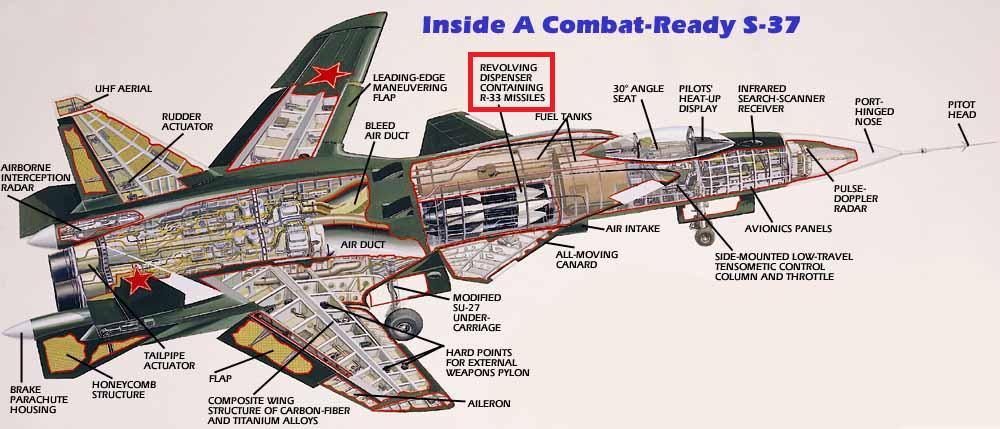
For high manoeuvrability and high angles of attack, the SU-47 Berkut (Golden Eagle), initially known as the S-37, uses a forward-swept wing configuration. The Su-47 completed the first stage of flight trials in December 2001.
Although the Russian aircraft was build as a testbed for developing fifth-generation technologies, in May 2002 Sukhoi was selected as prime contractor for the next-generation Russian PAK FA fighter programme. Although the SU-47 will be used for the PAK AF program, the design of it will probably be very different.

The Su-47 has extremely high agility at subsonic speeds, enabling the aircraft to alter its angle of attack and its flight path very quickly. It also retains it's high manoeuvrability in supersonic flight.

Maximum turn rates and the upper and lower limits on air speed for weapon launch are important criteria in terms of combat superiority. The Su-47 aircraft has very high levels of manoeuvrability with maintained stability and controllability at all angles of attack.
Maximum turn rates are important in close combat and also at medium and long range, when a mission may involve engaging consecutive targets in different sectors of the airspace.

The high turn rate of the Su-47 allows the pilot to turn the fighter aircraft quickly towards the next target to initiate the weapon launch. The swept-forward wing, compared to a swept-back wing of the same wing area, provides a number of advantages: higher lift to drag ratio; higher capacity in dogfight manoeuvres; higher range at subsonic speed; improved stall resistance and anti-spin characteristics; improved stability at high angles of attack; a lower minimum flight speed; and a shorter take-off and landing distance.

The SU-47's initial engine, the Saturn-Lulka Al-41F thrust vectoring engine was scarcely available, they were reserved for Mikoyan's Article 1.42 tests.
The final engine, the Al-37FU uses fuel instead of hydraulic liquid to drive the nozzles, and can be operated in two modes, automatic and manual. In automatic more, the axi-symmetric nozzles are controlled by the digital fly-by-wire flight control system (FCS).

Although the SU-47 was first seen as a demonstrator program it plays an important role in the PAK FA program, which is funded by India. Based on the SU-47, the Sukhoi PAK FA prototype is expected to begin flight testing no later than the end of 2007.